
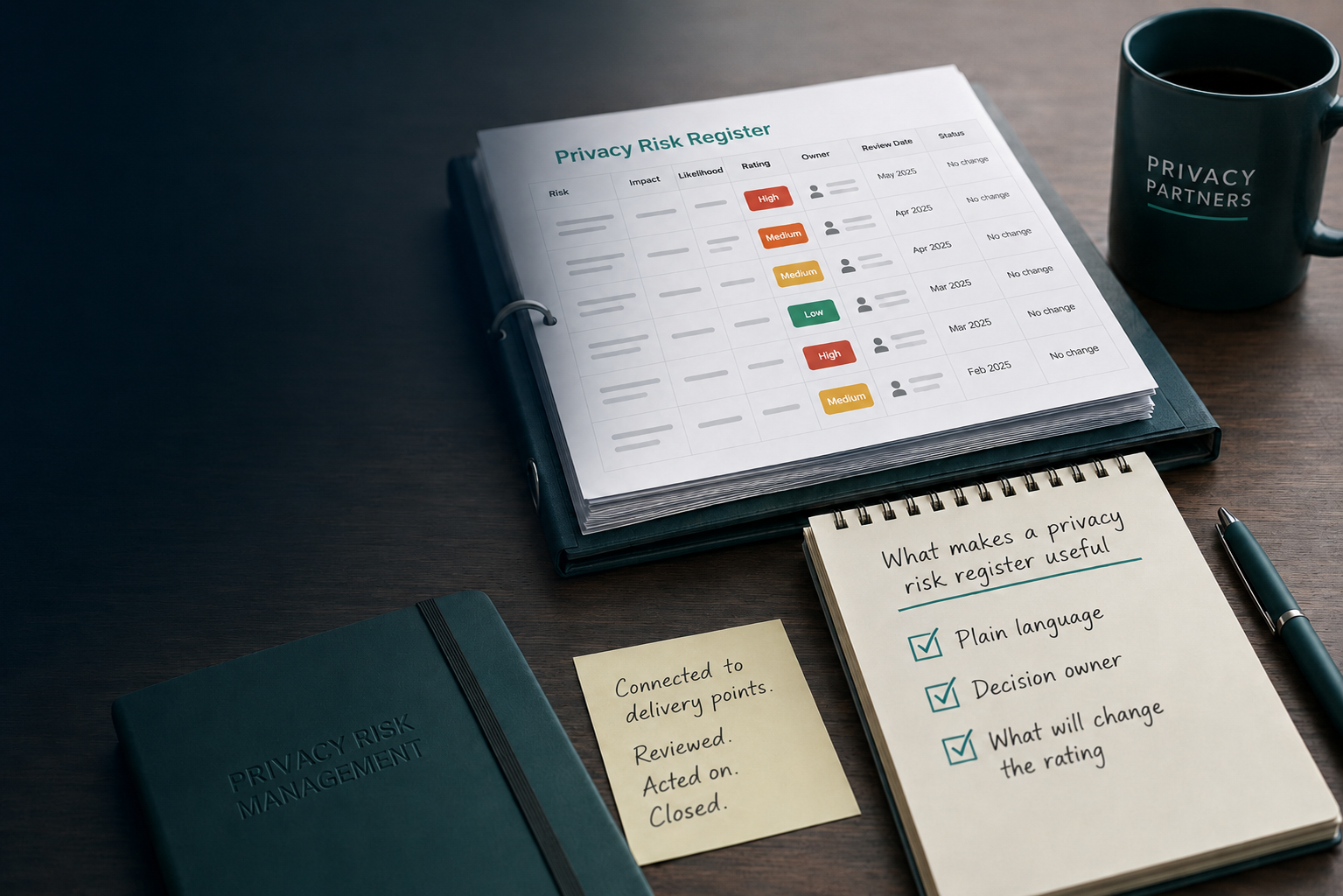
Why privacy risk registers stop being useful
Many organisations have a privacy risk register, but few trust it. The problem is rarely the template. It is usually ownership, review discipline, and weak links to operational decisions.
A privacy risk register should help a team make better decisions.
In practice, many do not.
They become long lists of issues with little context, vague owners, and review dates that move without any real change in exposure. When that happens, the register stops supporting action. It becomes a reporting artefact.
That creates a real business problem. Senior stakeholders think risk is being managed. Operational teams assume privacy has already reviewed the issue. The privacy function carries a false sense of coverage.
The underlying problem is usually not the register itself. It is the operating model around it.
A useful privacy risk register does three things well.
→ It captures the risk in plain language
→ It names the decision owner, not just the person who logged it
→ It shows what will change the rating up or down
Without those basics, the register becomes difficult to trust.
Another common problem is that risks are recorded too late. Teams often log them after a project has already gone live, after a vendor has already been approved, or after a process has already been embedded in operations. At that point, the register is documenting a problem rather than helping prevent one.
That is why timing matters. The strongest registers are connected to actual delivery points. Product reviews, procurement gates, change approvals, incident reviews, and annual control testing all create moments where privacy risk can be identified and reassessed.
The rating method also matters.
Some registers use broad labels like low, medium, and high without defining what those terms mean in practice. That tends to create inconsistent scoring. One person scores against legal exposure. Another scores against likelihood of complaints. A third scores against reputational impact. None of them are necessarily wrong, but they are not using the same lens.
A better approach is to agree a small number of factors that matter to the organisation. For example, scale of data, sensitivity, affected individuals, business dependency, and control strength. That gives the team a more stable basis for discussion.
It is also worth asking whether each logged item is really a risk. Some are actually control gaps. Some are decisions waiting for approval. Some are issues that should sit with security, procurement, or legal. If everything goes into one register, the signal weakens.
Good privacy risk management is not about collecting more entries. It is about making the register usable.
That usually means fewer items, better framing, clear ownership, and a regular process for closing the loop. If a risk has sat unchanged for six months, the question is not whether the date needs updating. The question is whether anyone is still using the register to make decisions.
A privacy risk register is valuable when it helps people act with more clarity. Once it becomes passive documentation, it is time to redesign the process around it.