
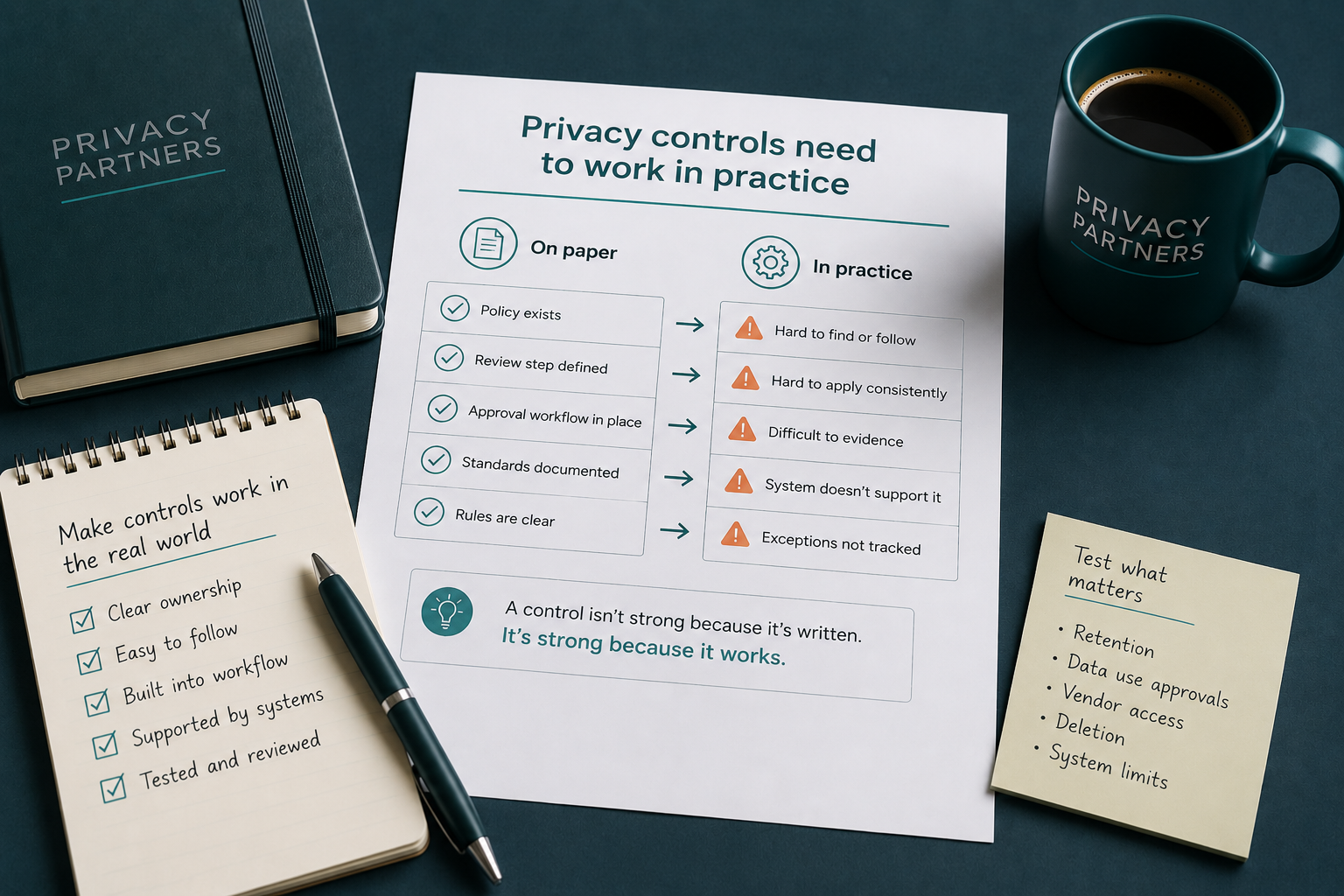
Too many privacy controls look strong on paper and weak in practice
Privacy controls often look mature in policy documents, but break down in day-to-day operations. Strong privacy risk management depends on testing whether controls work in practice, not only whether they exist on paper.
A common privacy problem is not the absence of controls.
It is the gap between what the organisation says it does and what actually happens in practice.
On paper, the position can look solid. There is a policy. There is a review step. There is an approval workflow. There is a standard on retention, access, or data sharing.
But when a real decision needs to be made, the control is harder to find, harder to follow, or harder to evidence than expected.
That gap matters because privacy risk is not reduced by written intent alone.
A control is only meaningful if the business can apply it consistently under normal operating conditions. That includes busy teams, competing deadlines, system limitations, and changing responsibilities.
This is where some privacy programmes become overconfident.
They treat the existence of documentation as evidence of control effectiveness. In reality, documentation is only the starting point. The next question is whether teams understand the rule, know when it applies, and can follow it without creating unnecessary friction.
Controls usually weaken for practical reasons.
→ Ownership is spread across too many teams
→ The process relies on memory rather than workflow
→ The business system does not support the stated rule
→ Exceptions are common but not tracked
→ Nobody checks whether the control still works after change
These are operational issues, not drafting issues.
That is why control testing should not sit only inside formal audit cycles. Privacy teams can learn a lot from smaller checks. Pick a control and follow it through real work. How is retention actually applied in a live system? How does a team approve a new data use? What happens when a vendor requests broader access? How is deletion handled when records sit across multiple tools?
Those checks often reveal the difference between a designed control and an operating control.
This does not mean every privacy rule needs heavy monitoring. It does mean high-value controls should be tested where the organisation depends on them most.
In many organisations, the best privacy improvements come from simplifying controls rather than adding more of them. A shorter approval path, a clearer decision owner, or a better trigger in an existing workflow can do more than another policy update.
Privacy risk management works best when controls are built for real use.
That sounds obvious, but it is easy to miss. Teams often invest most effort in defining the right rule, then far less effort in checking whether people can actually follow it.
If a control looks mature in a document but fails under routine pressure, the risk has not really been reduced. It has only been described more neatly.