
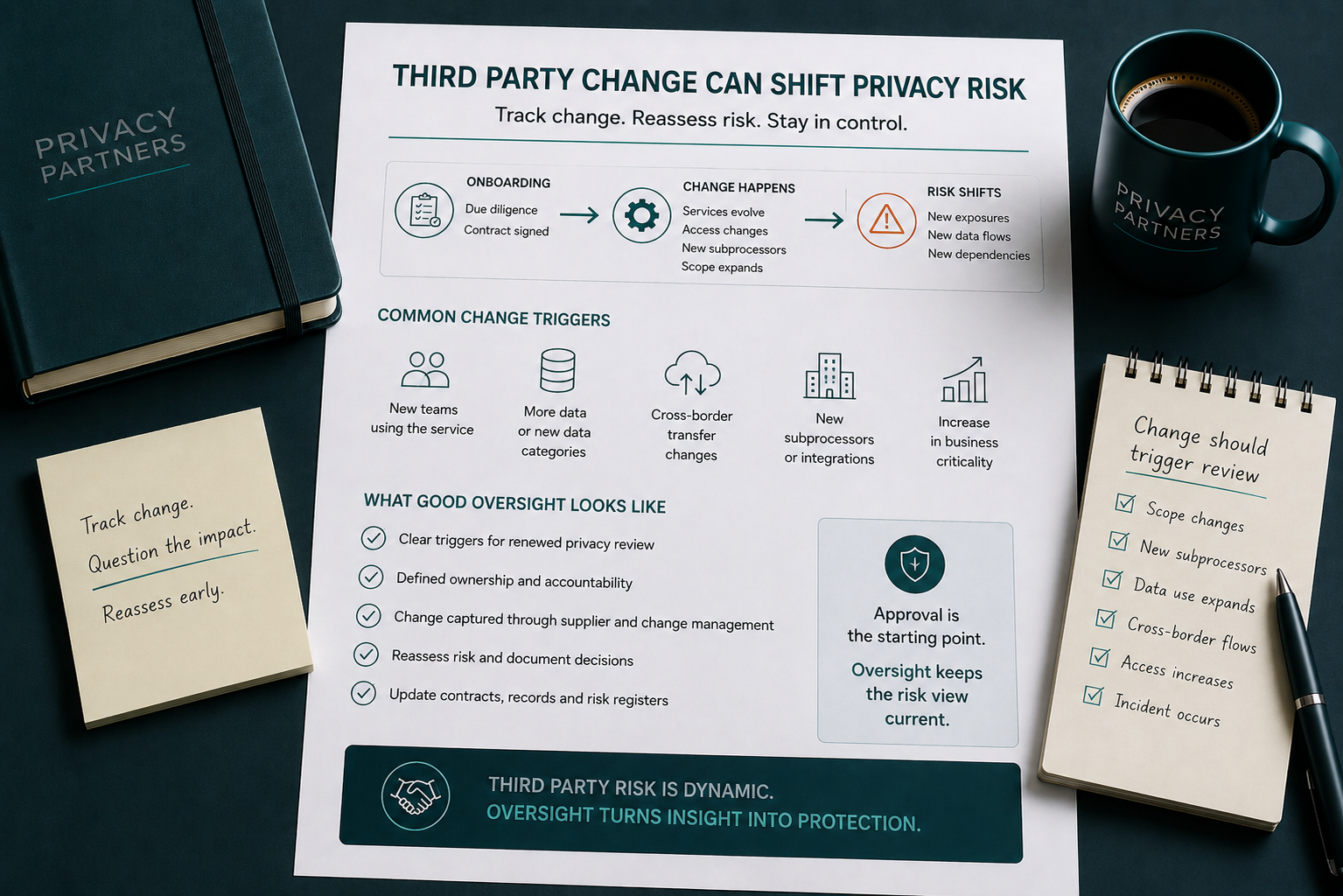
Privacy risk gets missed when third party change is poorly tracked
Initial vendor review is only part of the story. Privacy risk often grows later through service changes, new sub-processors, broader data use, and shifting access models that the organisation does not reassess in time.
Many organisations have a defined vendor onboarding review. Far fewer have an equally clear process for what happens next.
That matters because third party privacy risk does not stay fixed after contract signature. It moves as services evolve, access changes, subprocessors are introduced, integrations expand, and commercial pressure pushes teams to use tools in new ways.
If the organisation only assesses privacy risk once, it is likely to miss those shifts.
This is a common blind spot. The initial due diligence may be relatively strong. There is a questionnaire, a contract review, and a security assessment. But once the vendor is live, change is often handled informally. Business owners focus on delivery. Procurement focuses on commercials. Technology focuses on implementation. Privacy may not hear about the change until much later.
By then, the risk position may already have moved.
Some of the most important third party privacy questions appear after onboarding:
→ Has the vendor added a new subprocessor?
→ Has the scope of data use expanded?
→ Are more teams now accessing the platform?
→ Has personal data started flowing across borders in a different way?
→ Has the service become more business critical than originally expected?
None of these points automatically creates an unacceptable risk. The problem is when they happen without structured reassessment.
A practical response is to define clear triggers for renewed privacy review. That might include major contract amendments, new processing purposes, material data category changes, architecture changes, cross border transfer changes, or incidents involving the vendor environment.
The internal ownership model also matters.
If nobody is responsible for watching third party change after onboarding, privacy risk tends to surface only when something goes wrong. Stronger organisations assign that responsibility clearly and connect it to supplier management, contract governance, and operational change processes.
Another useful step is to distinguish between vendor approval and vendor oversight. Approval is the starting point. Oversight is the ongoing activity that keeps the original assessment relevant.
This is especially important where the organisation relies on a small number of vendors for high volume or high sensitivity processing. In those cases, even moderate changes can have a meaningful effect on privacy exposure.
Good privacy risk management recognises that third party risk is dynamic.
The aim is not to reassess everything all the time. It is to know which changes should trigger a fresh look, who should initiate it, and how the outcome should feed back into the organisation’s wider risk view.
That is usually where the real maturity lies.