
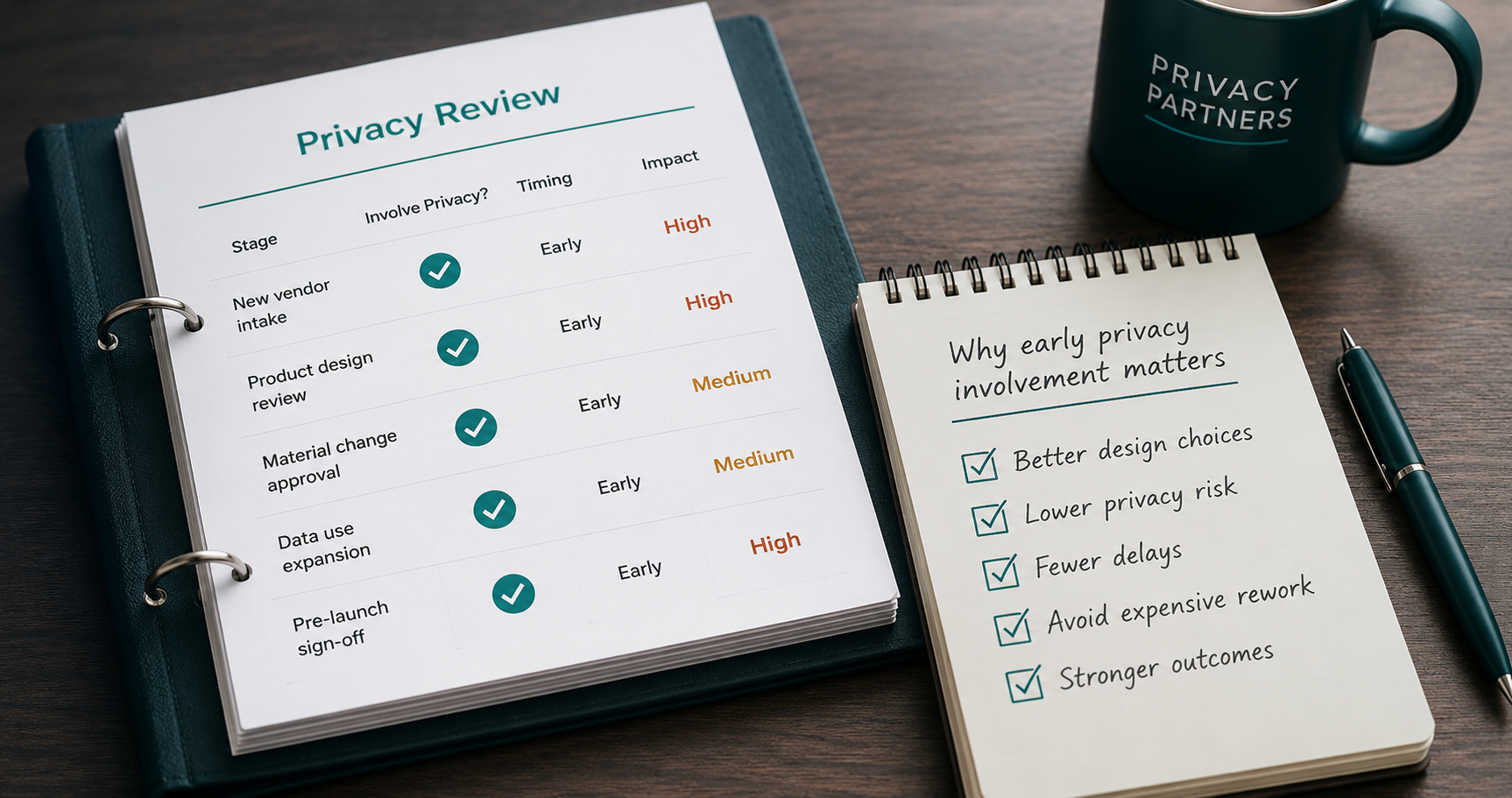
Privacy reviews are often late and that changes the whole conversation
Privacy risk management becomes much harder when review starts after design, procurement, or delivery choices are already fixed. Early involvement is not about slowing work down. It is about avoiding expensive rework.
A privacy review can be technically thorough and still arrive too late to help.
That is a common problem in organisations where delivery moves quickly and privacy is brought in near the end. By that stage, the core choices have often already been made. The vendor is selected. The product design is settled. The dataset is defined. The timeline is under pressure.
At that point, the privacy conversation changes.
Instead of asking what the most proportionate design looks like, the team starts asking how to make the existing plan acceptable. That often leads to friction, delay, or weak compromise.
This is not always caused by poor intent. In many cases, the business simply does not know when privacy input is most useful.
The answer is usually earlier than teams expect.
Privacy risk management adds most value when it shapes the decision, not when it is asked to validate the decision after the fact. That means getting involved when teams are still deciding what personal data is needed, where it will come from, who will access it, how long it will be kept, and whether a third party is essential.
Those are design choices. Once they are fixed, the room for improvement narrows quickly.
A practical way to improve this is to stop treating privacy review as a standalone event.
It works better when it is built into existing delivery points.
→ New vendor intake
→ Product design review
→ Material change approval
→ Data use expansion
→ Pre-launch sign-off
That approach does two things. It helps teams involve privacy at the right moment, and it avoids creating a separate process that people see as extra bureaucracy.
The trigger should be based on risk, not data volume alone. A small initiative can create significant privacy exposure if it uses sensitive data, introduces new monitoring, changes how individuals are profiled, or moves data into a new environment.
Another issue is that some teams only look for formal assessment triggers. They ask whether a DPIA is legally required, rather than asking whether early privacy input would reduce risk, rework, or design friction. That creates a narrow threshold mindset.
A better question is whether the decision changes the organisation’s privacy risk position in a meaningful way. If it does, the review should happen early enough to influence scope, design, data use, vendor choice, or controls.
The goal is not to insert privacy into every meeting. It is to create predictable moments where the right questions are asked before the hardest choices become difficult to reverse.
Late privacy review often feels painful because it is doing recovery work. Early privacy review feels more efficient because it is helping shape the path in the first place.
That is the difference organisations should aim for.