
Data flow mapping fails when it becomes a one-off exercise
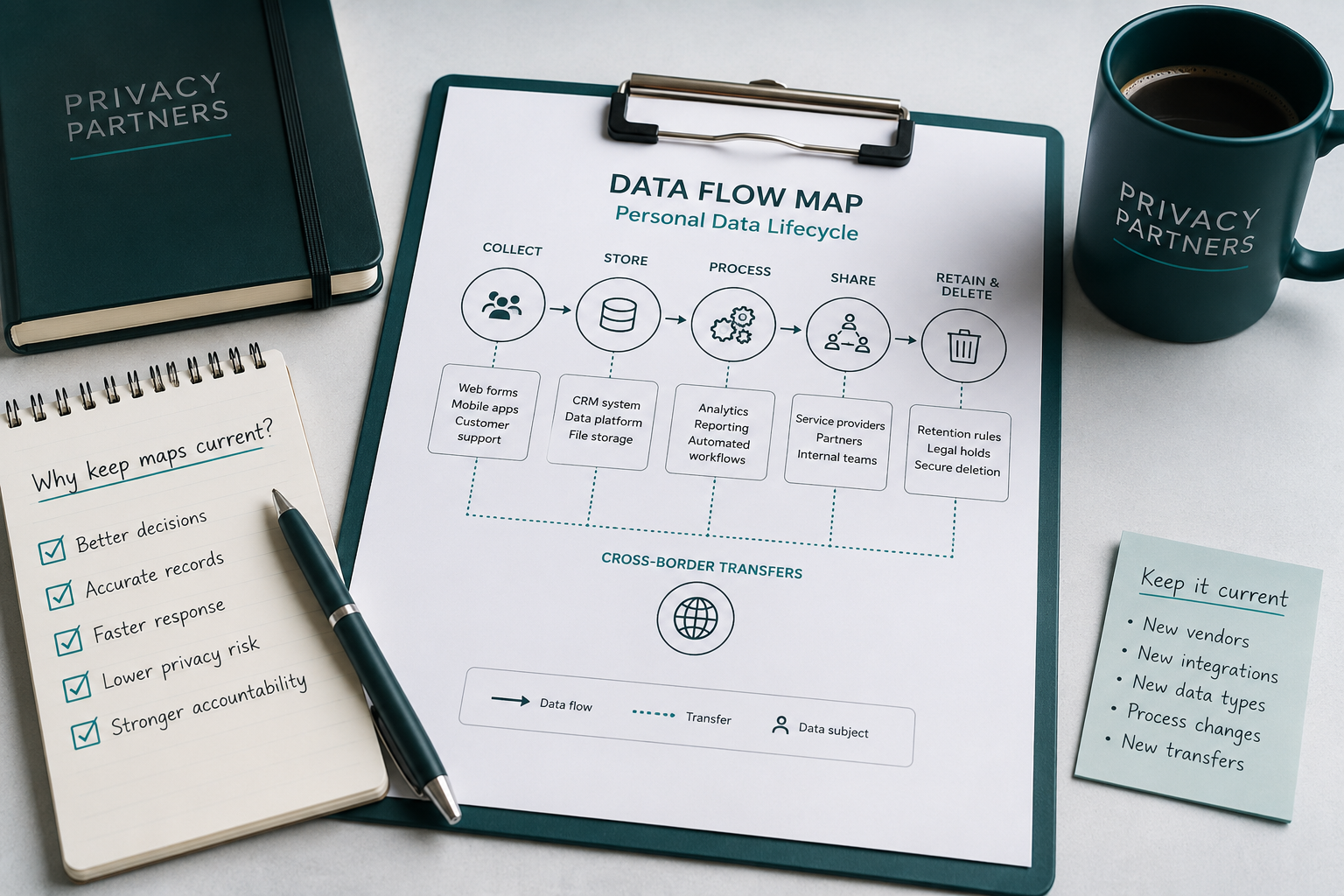
Many organisations build data flow maps during a project and never revisit them. That creates blind spots over time. A useful map is not just a diagram. It is a working view of how data moves in practice.
Most teams agree that data flow mapping matters.
The difficulty starts after the first version is produced.
A map is often created for a project, an audit request, or a regulatory response. It is detailed at the point of creation, then left untouched while systems, vendors, teams, and processes continue to change around it.
Over time, the map becomes less reliable. The organisation still refers to it, but with less confidence. That is where privacy risk starts to grow quietly.
An outdated data flow map creates several problems at once.
→ Privacy reviews are based on assumptions
→ Retention and deletion decisions become harder to validate
→ Incident response becomes slower
→ Records of processing begin to drift away from reality
This is why data flow mapping should not be treated as a one-off documentation task.
A useful map supports operational understanding. It shows where personal data enters the organisation, where it moves, who touches it, which systems are involved, and where transfers or concentration risks sit. It does not need to capture every technical detail, but it does need to be trustworthy enough for decision making.
That usually means designing the map around how the business actually works.
Some privacy teams build highly detailed diagrams that few people can interpret. Others keep them so high level that they miss the points where risk accumulates. The right level is usually the one that allows privacy, security, product, legal, and operational teams to use the same view without constant translation.
The maintenance model matters just as much as the initial build.
A map stays useful when it is connected to change.
That can include:
→ new vendors
→ new integrations
→ new categories of personal data
→ major process redesign
→ new international transfers
→ significant changes in user access or reporting logic
If none of those changes trigger an update, the map will drift.
Ownership is another weak point. Privacy may coordinate the work, but it rarely owns all the operational detail. The most reliable maps are maintained with the teams closest to the process. That often means operations, technology, product, procurement, and information security all have a role.
It is also worth being honest about the purpose of the exercise. If the map only exists because someone asked for it, the quality will usually fade after delivery. If it supports risk reviews, incident handling, retention design, and accountability evidence, it tends to stay closer to reality.
A good data flow map is not a static picture. It is a maintained working asset.
That shift in mindset matters. The point is not to produce a perfect diagram once. The point is to maintain a usable view of how personal data moves through the organisation as the business changes.